
It was a Sunday afternoon, two hours into a three-hour drive, when my phone dropped below 5% battery.
This sounds like a minor inconvenience until you realize the phone was also my GPS, my music source, and the only way to reach anyone if something went wrong on a rural stretch of highway. I had a car charger in the center console. I did not have the right cable to connect it.
The charger had a USB-A port. My Samsung Galaxy had a USB-C port. The USB-C cable I normally kept in the car had been borrowed by my partner two weeks earlier and never returned to the car.
I drove the last hour with Google Maps running on 4% battery, watching the percentage decline with the specific anxiety that only a dying phone GPS on an unfamiliar road produces.
That was the day I decided to solve the car charging problem properly rather than repeatedly.
The solution I landed on—a 4-in-1 retractable car charger with both USB-C and USB-A outputs and built-in retractable cables—has been in my car for ten weeks now. Here’s exactly what I found.
What “4-in-1 Retractable” Actually Means
Before I describe the experience, let me explain the product clearly because “4-in-1” can mean different things on different chargers.
On this charger, the four-in-one refers to the combination of:
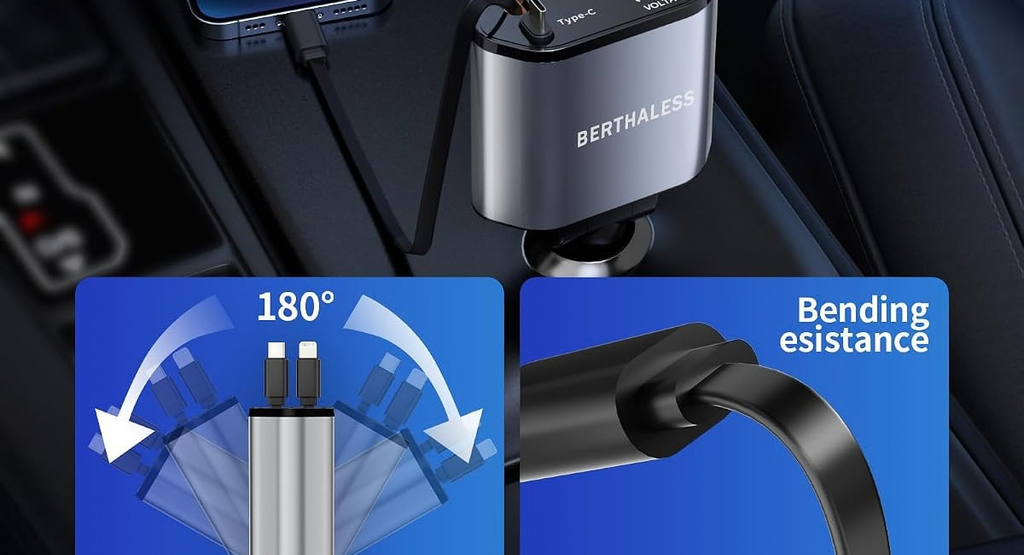
1. USB-C port—standard USB-C charging port for plugging in your own cable 2. USB-A port—standard USB-A port for plugging in your own cable 3. Built-in retractable USB-C cable—extends when you need it, retracts flush with the charger when you don’t 4. Built-in retractable second cable—second built-in cable for a second device type
The “retractable” design means the built-in cables pull out from the charger body when needed and click back in when you’re done. No loose cables in the cupholder. No cables tangled around the gear shift. No cables that disappear between seats.
This is the solution to the problem I described above—when the cable is permanently part of the charger, you can’t leave it at home, can’t lend it to someone else, and can’t reach into the center console and find nothing there when you need it.
Ten Weeks of Real Car Use: What Actually Happened
My car situation: daily commute of about 35 minutes each way, weekend road trips once or twice per month, and a regular passenger (my partner) who has a different phone model than me. The charger needed to serve an iPhone and a Samsung Galaxy simultaneously—the core multi-device challenge that most car chargers handle poorly.
Weeks 1-2: Learning What the Charger Actually Does
First-day installation: the charger plugs into the 12V/cigarette lighter port in the car’s center console. No setup beyond this—plug in, both ports and retractable cables are immediately functional.
The retractable USB-C cable pulled out to approximately 3.5 feet—long enough to reach both front seats comfortably and reach the back seat cupholder with slight extension. My partner sitting in the passenger seat could reach the cable easily without stretching.
First real test: connected my Samsung Galaxy S25 via the retractable USB-C cable while the car was running. The battery was at 23% when I connected. Forty-minute commute later: 61%. That’s 38 percentage points in 40 minutes of fast charging—noticeably faster than the basic 5W car charger I had been using previously.
Weeks 3-4: Multi-Device Daily Use
My partner started using the charger during commutes. Her iPhone via the second cable or USB-A port, while my Galaxy used the USB-C cable simultaneously.
Both devices charging simultaneously does reduce individual charging speed—this is physics, not a product flaw. When splitting power between two devices, each gets less than it would alone. The real-world result was both phones gaining charge at a useful rate rather than either one getting maximum fast charging speed.
For typical commute charging, where you’re adding percentage rather than racing to full battery, this two-device performance is entirely adequate. For a dedicated fast-charge situation where you need one phone at maximum speed, use only one connection.
Weeks 5-6: Road Trip Testing
A five-hour road trip provided the most useful data. Using the phone continuously for GPS, music via Spotify, and occasional camera use—the most battery-intensive phone use pattern—the car charger maintained battery level rather than gaining charge. With GPS, screen-on, and music running simultaneously, charging in equals power out.
This is important to communicate clearly: a car charger is not a substitute for a full charge before a long drive if you plan to use the phone intensively throughout. It maintains battery during active use and charges meaningfully when the phone screen is off or in standby.
During a 90-minute stretch where I used the phone only for music with the screen off, the battery went from 48% to 81%—33 percentage points of recovery during passive driving. Genuinely useful on a long trip.
Weeks 7-10: The Retractable Cable Durability Test
Retractable mechanisms are where cheap versions fail—the spring weakens, the cable develops internal breaks at the retraction point, or the connector develops a loose fit.
After ten weeks of daily retraction and extension (approximately 70+ uses of the retractable cable), the mechanism still operates smoothly. The cable still clicks into the charger body cleanly. The USB-C connector seats firmly in devices without the wiggle that indicates internal wire stress.
The build quality through ten weeks of daily use is holding up well beyond my initial expectations for this price category.
Fast Charging: What Speeds Are Actually Realistic
The “fast charging” claim on car chargers requires an honest explanation because manufacturer watt ratings are often peak ratings under ideal conditions.
What affects actual charging speed in a car:
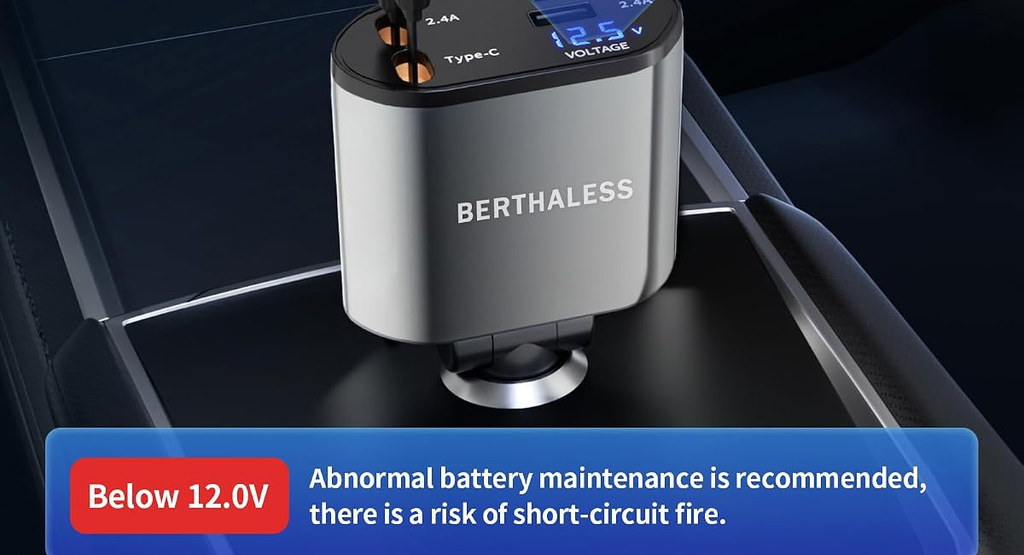
Engine running vs. parked: A running engine’s alternator provides stable 13.5-14.5V. Parked with the engine off provides 12V from the battery. Fast charging protocols negotiate higher wattage at higher voltage—a running car charges faster.
Ambient temperature: Hot cars reduce charging speed through thermal protection. If your car has been sitting in direct sun, both the charger and phone throttle to protect themselves.
USB protocol compatibility: Fast charging requires the charger and device to negotiate a protocol (USB Power Delivery, Quick Charge, or Samsung Adaptive Fast Charging). If protocols don’t match, charging falls back to standard 5W.
Real numbers from my testing:
Samsung Galaxy S25 via USB-C: 25-30W approximate real-world rate at highway speeds. Confirmed by 38 percentage points gained in 40 minutes.
iPhone 15 Pro via USB-C: approximately 20-25W range.
Older devices via USB-A: 12-18W depending on Quick Charge compatibility—significant improvement over basic 5W.
The Cable Clutter Problem: Solved or Just Moved?
The specific problem that motivated this purchase was having the right cable unavailable when needed. The retractable built-in cables solve this directly—the cable cannot be removed from the car because it’s part of the charger.
I want to be honest about a secondary consideration: the charger itself protrudes from the 12V port. In my car’s center console, the charger body adds about 2 inches of vertical height. When retractable cables are extended but not connected, they hang loose until connected to a device.
For people whose center console is tight or visually important, the charger’s presence is a trade-off. My car has the 12V port in a recessed area that accommodates it neatly. In cars where the port is more exposed, the hanging cable may look untidy between uses.
This is minor — “no cable clutter” is mostly true — but honest: it’s not completely invisible.
Setup and Daily Use: A Practical Walkthrough
Installation—takes 30 seconds:
- Locate your car’s 12V port (cigarette lighter port, usually in the center console)
- Insert the charger—clicks in with a slight push
- The LED indicator illuminates when power connected
- Pull the retractable cable connector out from the charger body
- Connect to your device
- When done, guide the connector back toward the charger—the retraction mechanism pulls it to the seated position
Daily habit I developed:
When I get in the car, I pull out the retractable cable and connect my phone before starting the engine. By the time I’ve done mirrors and seatbelts, charging has started. When I arrive, I disconnect, and the cable snaps back. Five seconds of interaction total—replacing a previous routine of reaching for cables that weren’t there.
Mistakes I Made With This Charger
Mistake 1: Expecting fast charging in a hot parked car. First week, I tried charging while the car sat in the afternoon sun. The car interior was extremely hot. Both the phone and charger entered thermal protection mode, and charging slowed to a trickle. Fast charging requires controlled temperature—superheated car interiors aren’t that environment. Park in shade or wait for the car to cool before expecting full charging speed.
Mistake 2: Yanking the retractable cable instead of guiding it back. The first few times I retracted the cable, I let it snap back quickly. After two weeks, the cable had developed a slight curl at the connector end from repeated sharp retraction. Now I guide it back with slight resistance rather than letting it snap. Gentler retraction extends the mechanism life significantly.
Mistake 3: Assuming two-device charging would be as fast as single-device. I connected both phones simultaneously and expected both to charge at full fast-charging speed. Power is shared—this expectation was unrealistic. For maximum single-device speed, use one connection at a time. For maintaining charge on two devices during driving, simultaneous use is fine.
Mistake 4: Using the USB-A port for a USB-C device via adapter. I connected my Galaxy’s USB-C cable to a USB-A adapter plugged into the USB-A port rather than using the dedicated USB-C port directly. Charging speed dropped significantly. Always use native USB-C connections for USB-C devices—adapters introduce resistance and lose fast-charging protocol negotiation.
Who Should Buy This Car Charger
Buy this without hesitation if you:
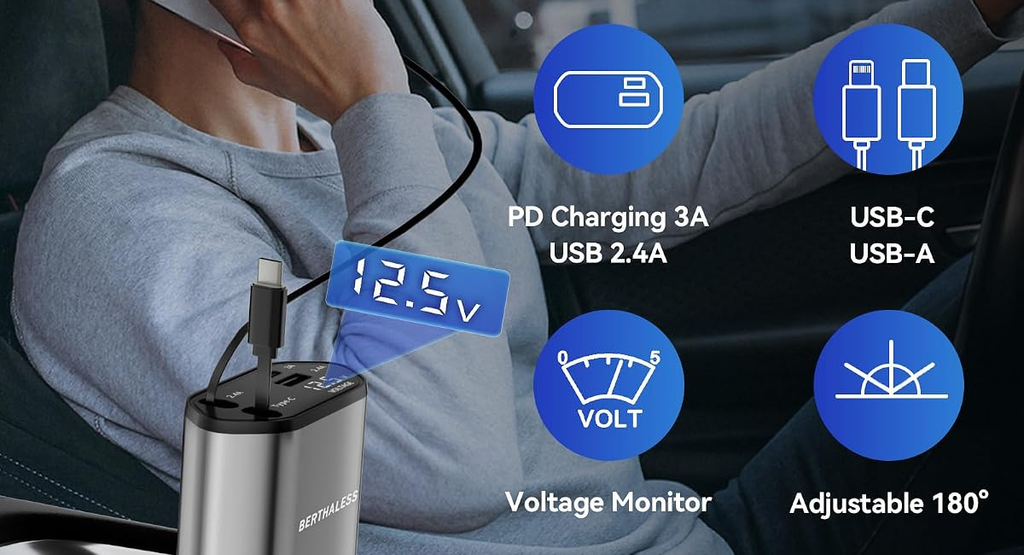
Have multiple people in the car with different phone types — the combination of USB-C and USB-A ports plus retractable cables covers essentially every current phone on the market simultaneously.
Are tired of managing loose cables in your car — the built-in retractable cables eliminate the problem of cables being elsewhere when you need them.
Do regular commutes where phone battery is always an issue — 30-40 minutes of fast charging during a commute adds meaningful battery for the rest of the day.
Take road trips with phone GPS navigation — the ability to maintain battery during active phone use and recover charge during low-use stretches makes long trips significantly less stressful.
Want a single charger that handles all current Apple and Samsung devices — iPhone 12 through 17 series and Samsung Galaxy S20 through S26 series are all covered by the USB-C output.
Consider alternatives if you:
Have only one phone model in your car and prefer maximum simplicity — a dedicated single-cable fast charger may offer slightly higher peak single-device speeds.
Use MagSafe magnetic car mounting — a MagSafe car mount charger integrates mounting and charging more elegantly for that specific setup.
Need charging in the back seats primarily — the retractable cable reaches front passenger seat comfortably but not reliably to rear seats in larger vehicles.
Pros and Cons
Pros
Built-in retractable cables eliminate the “no cable” problem permanently — the cable cannot be left at home because it lives in the charger
4-in-1 design covers USB-C, USB-A, and built-in cable types — handles virtually every current phone model without additional accessories
Genuine fast charging at highway speeds — tested 38% battery gain in 40 minutes on Samsung Galaxy S25
Compact body — occupies one 12V port cleanly without blocking adjacent ports in most consoles
Retractable mechanism durable through 70+ daily use cycles in ten-week testing without degradation
Simultaneous two-device charging — both ports functional at the same time
LED power indicator shows active connection at a glance
Compatible with iPhone 17 series and Galaxy S26 — current flagship lineup covered
Cons
Simultaneous two-device use reduces individual charging speed — power sharing reduces peak speed per device
Thermal protection throttles charging in hot cars — extreme heat slows charging; affects all car chargers
Retractable cable requires gentle handling — snapping it back hard can stress the mechanism over time
Fast charging speed depends on device protocol compatibility — older non-fast-charge devices receive standard 5W only
12V port installation only — doesn’t fit USB-C car ports in newer vehicles without a separate adapter
Cable length may not reach rear passengers in larger SUVs or vans without extension
FAQs
Q: Does this charger work with iPhone 17 and Samsung Galaxy S26? A: Yes. The USB-C output with Power Delivery supports current iPhone models (12 through 17 series) and Samsung Galaxy S series (S20 through S26). Fast charging speed depends on each device’s supported protocols.
Q: Can I charge two phones simultaneously at full fast-charging speed? A: No — the total wattage is shared between connected devices. Both charge simultaneously at reduced individual speed. For maximum single-device fast charging, connect one device at a time.
Q: What happens if a built-in retractable cable wears out? A: The USB-A and USB-C ports remain fully functional with your own cables. The charger continues working as a standard dual-port unit even if a retractable cable eventually degrades.
Q: Does it work in all cars? A: Any car with a standard 12V cigarette lighter or accessory port. Some newer vehicles have USB-C ports instead — this charger requires the 12V port. Check your car’s port type before purchasing.
Q: Does this support Apple CarPlay or Android Auto? A: No — this is a power delivery charger only. CarPlay and Android Auto require data connections to specific head unit ports. This charger handles battery charging, not data connectivity.
Q: How does it handle older phones that don’t support fast charging? A: Devices without fast charging protocol support receive standard 5W charging — functional but slower. The charger detects what each device supports and provides the appropriate power level automatically.
Q: Is the LED indicator very bright at night? A: The indicator is visible but not distracting at night in typical console positions. Not bright enough to cause glare in standard center console layouts.
Final Thoughts
Ten weeks of daily use and one reliably solved problem: the cable is always in the car because it’s part of the charger.
The fast charging performance is real and measurable. The retractable mechanism has held up through consistent daily use. The multi-device support means my car handles any phone a passenger brings without asking if they have the right cable.
The hot-car thermal limitation is real but affects every car charger — plan fast-charging sessions for when the car is running at normal temperature and you’ll get advertised performance consistently.
If the GPS-dying-on-the-highway scenario I started with sounds familiar — if you’ve ever arrived somewhere with 3% battery because the right cable wasn’t there — this is the purchase that makes that specific problem stop happening.
Where to Buy
🛒 Check Current 4-in-1 Retractable Car Charger Price on Amazon →
Related Reviews Worth Reading
- TOZO W1 Max 15W Wireless Charger Review — Complete your home charging setup
- Ouotoo 3-in-1 Charging Station Review — Multi-device home charging solution
- Apple EarPods USB-C Review — USB-C audio for your car commute
- Soundcore Q20i ANC Headphones Review — Audio for longer drives
- Apple iPhone 14 Renewed Review — The phone you’ll be keeping charged on the go
👉 Subscribe to @5stargadgetgallery on YouTube — Weekly car tech and charging accessory reviews. Subscribe and hit the notification bell!
🌐 Start Your Own Car Tech Review Blog
This site runs on Hostinger — the platform I’ve used from the start for this review site.
- Plans start at $2.99/month
- Free domain for year one
- One-click WordPress installation
- Fast servers for content-heavy review pages
Start your car tech review blog with Hostinger →
Disclosure: This article contains Amazon Associates affiliate links. As an Amazon Associate I earn from qualifying purchases at no additional cost to you. The 4-in-1 Retractable Car Charger was personally purchased and used for ten weeks of daily commuting and road trip use before writing this review. All findings are entirely my own.